


“This blog provides the following insights:
- You will understand what ‘Zen’ is in Japan.
- It serves as a guide for those who wish to live like samurai or ninja.
- You will learn ways to make your life easier.”
 YUJIRO
I’m a Japanese practitioner who has been studying Zen and practicing zazen for 20 years, and I’ll introduce it to you!
What is Zen? Explained by a Japanese Zen practitioner.
In the Buddhism that has been passed down in Japan, there are several sects, most of which rely on the scriptures and words to study the teachings. Zen, on the other hand, emphasizes experiencing the enlightenment of the Buddha firsthand through practices such as zazen (seated meditation). Incidentally, the word ‘Zen’ itself means focusing the mind on one thing, which can also be described as a form of mental concentration.
Why did samurai incorporate Zen practice?

Zen became an independent sect in Japan during the early 13th century, in the Kamakura period. The key figures were Eisai and Dogen, both of whom originally studied Tendai Buddhism and later traveled to the Song dynasty for further study. Eisai established the Rinzai school, which became the first Zen sect in Japan.
There are various theories about how Zen Buddhism was transmitted from China to Japan, but the most popular one is that it was brought back by Eisai (1141–1215), a Japanese Buddhist monk who studied in China.
In the mid-Kamakura period, around 1274, Japan faced its greatest external threat. The Mongol army, aiming for world domination, began its invasion of Japan. During this time, Hojo Tokimune, the regent of the Kamakura shogunate, overcame the immense pressure of Japan’s greatest crisis through Zen practice.
Samurai had the duty of fighting to protect their lords. Their job was to kill or be killed. They honed their martial arts skills to avoid death, but that alone was not enough. On the battlefield, the pressure often prevented them from executing the techniques they had practiced. Given that Zen was integrated into Japanese policy at the time, many samurai devoted themselves to Zen training, learning how to focus on the present moment, overcome daily fears, and fully utilize their abilities in actual combat.
Zen Applied in Modern Times

It is said that Steve Jobs (1955-2011), the founder of Apple Computers, also studied Zen. As the global marketplace expands, modern business leaders increasingly find themselves not only concerned with their own company’s profits but also intertwined with the global economy, politics, and various environmental changes. Rather than relying solely on specialists, leaders must be personally involved at a practical level, making clear decisions. In the age of networking, where a vast amount of information and diverse values are constantly exchanged, it becomes essential to maintain creativity, innovative vision, and a judgment free from fixed ideas.
In this context, the need for Zen, including mindfulness as a practical mindset for coaching and counseling, is growing. In other words, modern business leaders are increasingly finding themselves in a position similar to that of samurai.
Zen Practice and Its Benefits
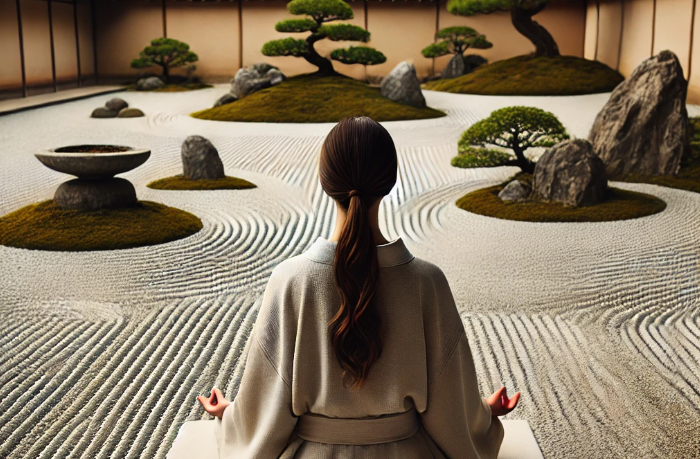
Zazen, through breathing techniques and introspective training, helps regulate the autonomic nervous system, which controls most of the body’s automatic functions. It is a form of training that indirectly allows consciousness to reach the unconscious realm. Through this practice, we observe the traumas, fixed ideas, and thought patterns stored in the unconscious with a conscious mind. The goal is to prevent these unconscious traumas, fixed beliefs, and thought patterns from dominating our conscious awareness.
This training also brings physical balance, promoting health and providing a fitness-like effect, while calming the mind and improving decision-making abilities. To start, don’t overthink it—find a comfortable posture, breathe slowly, and focus on your breathing. Pay attention to the air as it enters your lungs and passes through your throat. Concentrate on that sensation, and avoid dwelling on unpleasant past memories or future anxieties.
Don’t make it complicated. Try practicing for about a week, even just 3 to 5 minutes a day. If you can maintain it, you’ll likely find that negative thoughts occur less often than before.
That was Zen Meditation from a Japanese Practitioner: A Guide to Mindfulness!









コメント